Page loading




Flyer
-

 Authors
 -
Chronological
- • 1977 (1-12)
- • 1978 (13-23)
- • 1979 (24-27)
- • 1980 (28-39)
- • 1981 (40-52)
- • 1982 (53-64)
- • 1983 (65-74)
- • 1984 (75-97)
- • 1985 (98-114)
- • 1986 (115-120)
- • 1987 (121-127)
- • 1988 (128-134)
- • 1989 (-)
- • 1990 (135)
- • 1991 (136-138)
- • 1992 (139-144)
- • 1993 (145-153)
- • 1994 (154-163)
- • 1995 (164-172)
- • 1996 (173-188)
- • 1997 (189-194)
- • 1998 (195-196)
- • 1999 (197-201)
- • 2000 (202-206)
- • 2001 (207-213)
- • 2002 (214-220)
- • 2003 (221-224)
- • 2004 (225-226)
- • 2005 (227-229)
- • 2006 (230-231)
- • 2007 (232-237)
- • 2008 (238)
- • 2009 (239-247)
- • 2010 (248)
- • 2011 (249-251)
- • 2012 (252-255)
- • 2013 (256)
- • 2014 (257)
- • 2015 (-)
- • 2016 (258-260)
- • 2017 (261-263)
- • 2018 (264-269)
- • 2019 (270-273)
- • 2019 (274-276)
- • 2021 (277)
- • 2022 (278-281)
- • 2023 (282-284)
- • 2024 (285-285b)
- • 2025 (286-288)
- • 2026 (289)
-
Des barbares...
-
Biblioteratology
- • 01. Chez les brocheurs [1]
- • 02. Chez les éditeurs[1]
- • 03. Chez les relieurs [1]
- • 04. Chez les relieurs [2]
- • 05. Chez les éditeurs [2]
- • 06. At the readers [1]
- • 07. Chez les éditeurs [3]
- • 08. Chez les éditeurs [4]
- • 09. Chez les éditeurs [5]
- • 10. Chez les relieurs [3]
- • 11. At the bookstores [1]
- • 12. Among layout designers [1]
-
Entertainments
-
Fin-de-Siècle
-
Fourneau and Fornax
-
Printings
-
Typography


est un éditeur artisan établi en Champagne (dans le petit village de Bannes)
qui a aussi eu pendant 26 ans un atelier en Île de France (dans le petit village de Paris),
mais ne l'a plus.
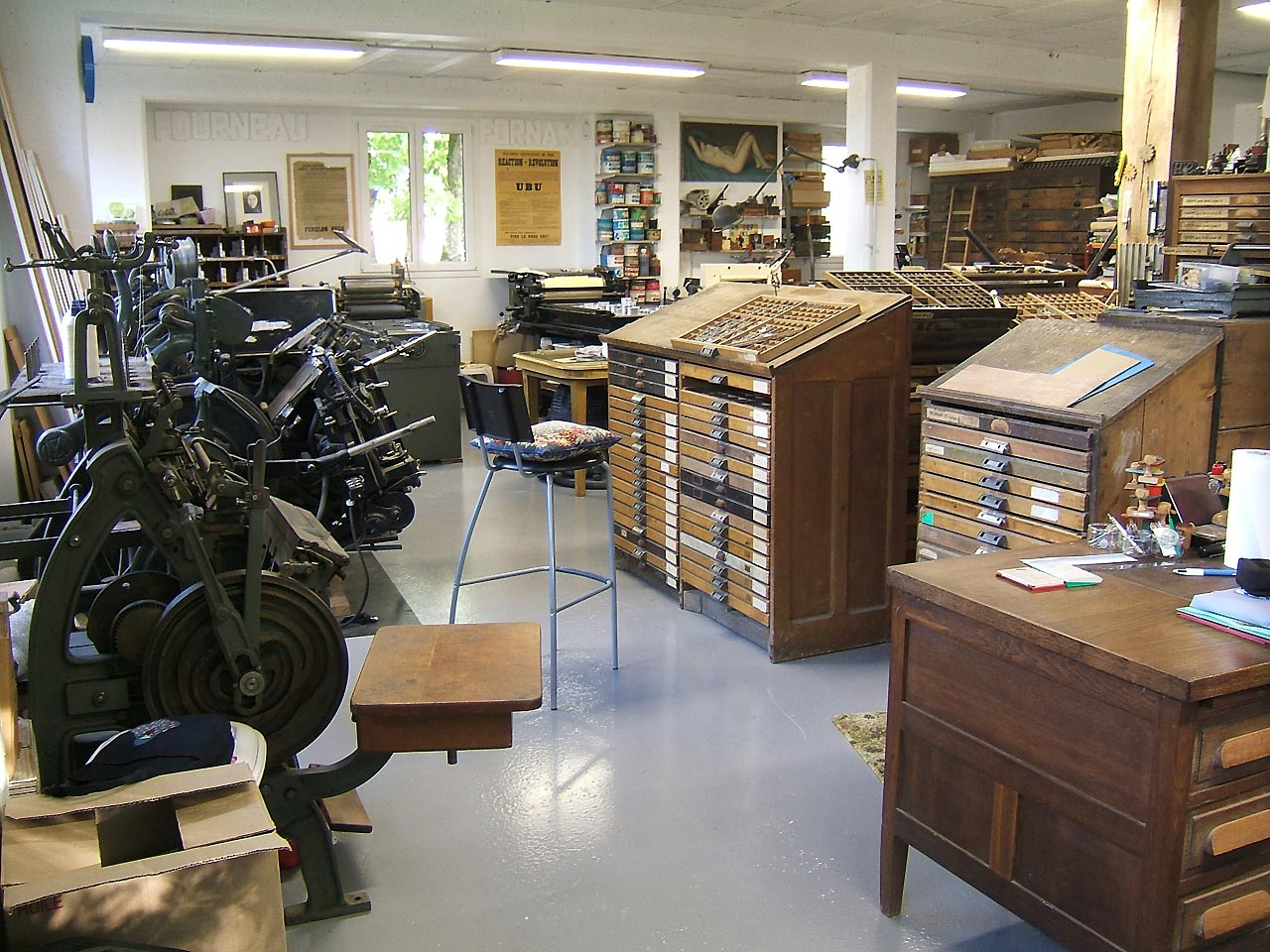
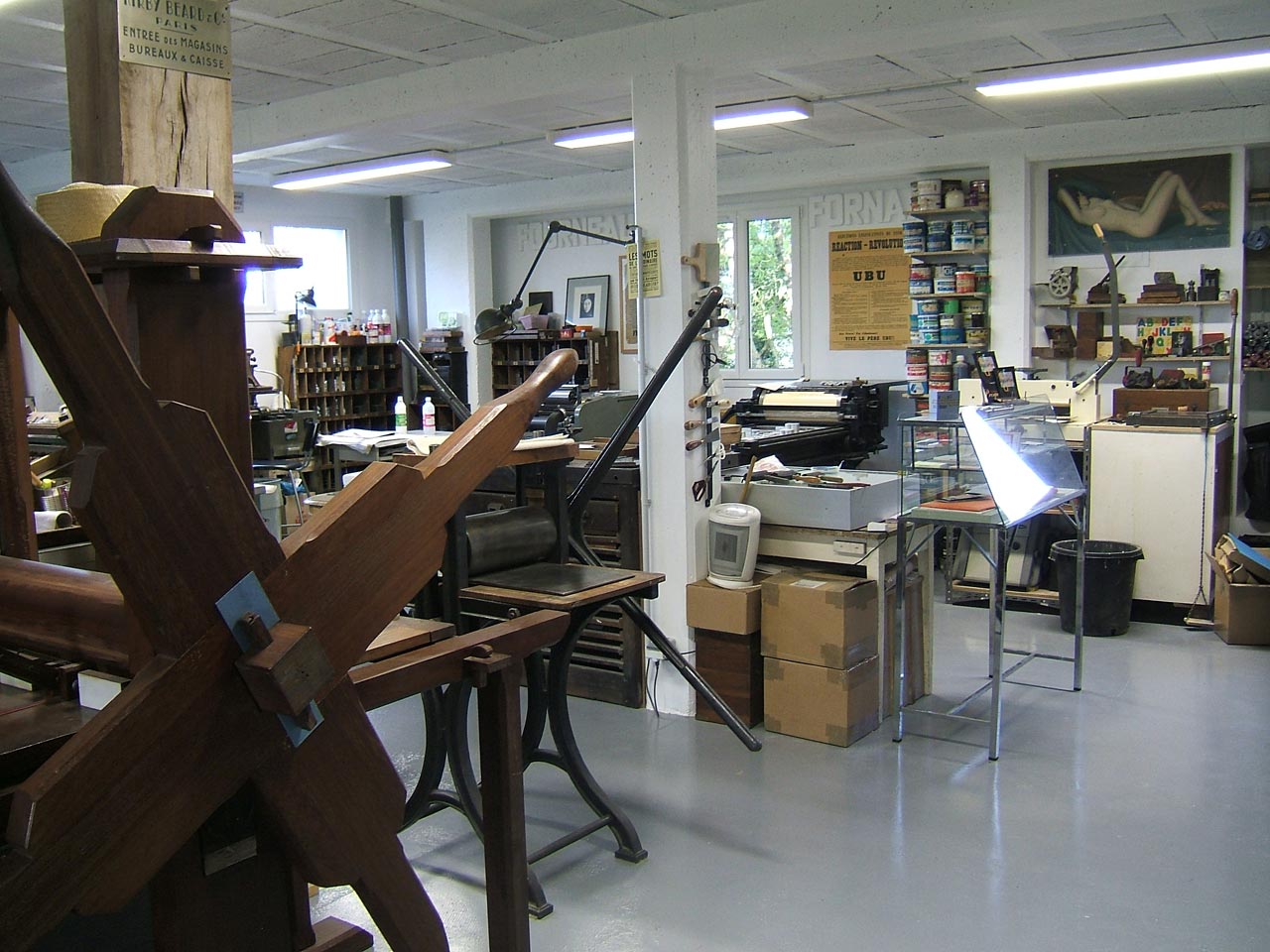
L'atelier de Bannes.

To my friend Jean-Paul Goujon
“You didn’t post your usual piece last Monday…”
“Nope…”
“Couldn’t be bothered?”
“Nope. I was ill…”
“Oh! And that stopped you writing your post?”
“Well, yes… I wasn’t much in the mood. I decided the best way to nurse myself back to health was to do absolutely nothing.”
“And did it work?”
“Well, yes, a little. It does you good to do nothing every now and then. Gives you a rest. And rest can be a bit of a cure in itself, sometimes.”
“Yes, but not always…”
“No, not always… but in this case, yes. A little…”
“And are you going to write your post after all?”
“Well, yes. I’m writing it right now…”
“Oh, I see… In that case, I’ll leave you to it.”
“Thank you…”
I’m not one to complain, but some people are really quite… Anyway, let’s move on.
Now, let’s see… Ah, yes! A little while ago, certain people—ill-mannered souls, no doubt—responded to my work with a rather eloquent curl of the lip and remarks along the lines of: “Er, don’t take this the wrong way, but all that stuff you write about printing and technology… well, how shall I put it? We couldn’t give a damn!” Always a pleasure to hear, isn’t it? So, just to be absolutely clear, I’m not changing the subject to please them. Not at all. I’m changing it because, as someone once said, I simply can’t be bothered to carry on with the usual stuff. I’m not feeling particularly sprightly or full of beans just yet.
I’ve therefore decided to indulge the devotees of fin-de-siècle literature—that is, literature from the end of the nineteenth century—and its early twentieth-century successors. Some fifty years ago, there weren’t all that many of us who knew about this literature, let alone appreciated it. Nowadays, you can hardly get a foot in the door for the crowds. Times change. It’s like the weather: things are warming up.
So here’s what I propose. I’ve taken an issue of a literary magazine from a shelf in my library—one within easy reach, which isn’t true of all of them. I picked it more or less at random. Did chance do me a good turn? I think it did, but you can be the judge.
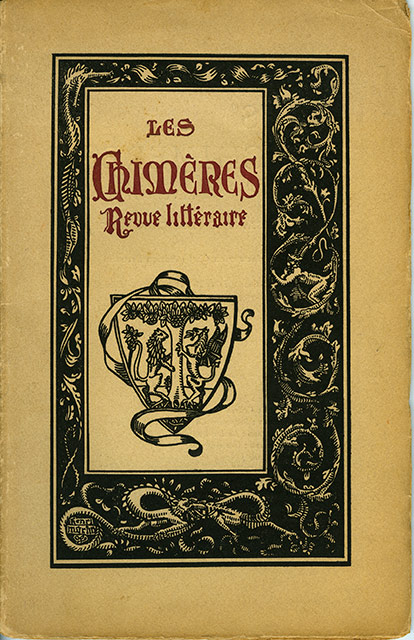
Les Chimères
A poetry magazine, published on the fifteenth of every month
Paris, 76 rue du Rocher
Volume II, No. 11 — 15 February 1909 — 28 pages
Editor-in-chief: Adrien Bertrand
Editorial committee: Guy Robert du Costal, Alfred Machard, Claude-Léon Mercerot, Vincent Muselli, Henri Grach
Secretary-general: Henry Bertrand
Administrator: René Emanuelli
Contents
Émile Boissier, “Annick” — A poem dedicated to Frédéric Mistral, consisting of eleven quatrains in ten-syllable lines.
Guy Robert de Costal, “Sonnets” — Two monosyllabic sonnets, the first of which I simply cannot resist quoting in french, of course:
La More
Dort
Son
Corps
Blond
Sur
Le
Lit
Dur.
Frêle
Sœur
Qui
Gît !
Pâle
Fleur…
Roger Vincent, “Souvenir” — “Chanson” — “Idylle anglaise” — Three poems: a sonnet; a poem comprising six quatrains of three seven-syllable lines and one two-syllable line; and a poem of ten quatrains in eight-syllable lines.
Adrien Bertrand, “La Douleur” — A poem dedicated to Théo Mittelsten Scheid, consisting of six six-line stanzas in alexandrines.
Alfred Machard, “Une escapade” — A short story featuring the child characters the author was so fond of.
E. Aubel, “Sonnet” — A sonnet in alexandrines, dedicated to Louis Perris.
Gaston Guilleré, “Mimodrame” — A sort of prose poem featuring the character of Pierrot.
Vincent Muselli, “Poème” — A poem consisting of three quatrains in alexandrines, dedicated to Édouard Marye.
André Petit, “L’Éveil de l’été” — A sonnet in alexandrines.
Edmée Delebecque, “Supplique” — “Dédicace” — Two poems in alexandrines: the first consists of seven quatrains, the second of sixteen lines.
Xavier Thylda, “Celles qui passent…” — “Dormeuse” — “Stances” — Three poems in alexandrines: two sonnets and a poem of two quatrains dedicated to Guy Robert du Costal.
André Petit, “Nuit” — A sonnet in alexandrines.
“Une Matinée” — An anonymous review of a literary matinée held at the Lemoine Hall, 17 rue Pigalle.
Finally, a statement by Adrien Bertrand announcing his resignation as editor-in-chief of the magazine so that he could take up the mantle of secretary to the committee charged with erecting a monument in honour of Catulle Mendès, who had recently ceased to be immortal.
“Tell me, sorry to butt in again… These chaps in your magazine aren’t exactly household names, are they?”
“No, they aren’t.”
“And if they seem rather partial to women, they don’t appear to pay them much attention. Not a single woman in the contents… So why are you bothering to write about them?”
“Oh, just to make them a little better known…”
“Right… Fair enough. But do you really think your pathetic little blog post is going to make your second-rate poets famous?”
“No, probably not… But perhaps some newly converted fin-de-siècle enthusiast might be tempted to dig a little deeper and take an interest in one or another of them. You never know…”
“Hmm… Possibly. But now that I think about it, your obscure dreamers seem a pretty reactionary bunch, what with their sonnets on every street corner. Not exactly modernists, are they? They don’t seem to invent much, with all that ice-cold classicism of theirs. They churn out alexandrines by the yard…”
“Fair point… But they do help us build up a little picture of the period. The Symbolists are more or less behind us, and Dada won’t be long in coming. In the meantime, there they are, these fellows… still here, just before the Great War comes along and kills them.”
“Hmm…”
To my friend Jean-Paul Goujon
“You didn’t post your usual piece last Monday…”
“Nope…”
“Couldn’t be bothered?”
“Nope. I was ill…”
“Oh! And that stopped you writing your post?”
“Well, yes… I wasn’t much in the mood. I decided the best way to nurse myself back to health was to do absolutely nothing.”
“And did it work?”
“Well, yes, a little. It does you good to do nothing every now and then. Gives you a rest. And rest can be a bit of a cure in itself, sometimes.”
“Yes, but not always…”
“No, not always… but in this case, yes. A little…”
“And are you going to write your post after all?”
“Well, yes. I’m writing it right now…”
“Oh, I see… In that case, I’ll leave you to it.”
“Thank you…”
I’m not one to complain, but some people are really quite… Anyway, let’s move on.
Now, let’s see… Ah, yes! A little while ago, certain people—ill-mannered souls, no doubt—responded to my work with a rather eloquent curl of the lip and remarks along the lines of: “Er, don’t take this the wrong way, but all that stuff you write about printing and technology… well, how shall I put it? We couldn’t give a damn!” Always a pleasure to hear, isn’t it? So, just to be absolutely clear, I’m not changing the subject to please them. Not at all. I’m changing it because, as someone once said, I simply can’t be bothered to carry on with the usual stuff. I’m not feeling particularly sprightly or full of beans just yet.
I’ve therefore decided to indulge the devotees of fin-de-siècle literature—that is, literature from the end of the nineteenth century—and its early twentieth-century successors. Some fifty years ago, there weren’t all that many of us who knew about this literature, let alone appreciated it. Nowadays, you can hardly get a foot in the door for the crowds. Times change. It’s like the weather: things are warming up.
So here’s what I propose. I’ve taken an issue of a literary magazine from a shelf in my library—one within easy reach, which isn’t true of all of them. I picked it more or less at random. Did chance do me a good turn? I think it did, but you can be the judge.
Les Chimères
A poetry magazine, published on the fifteenth of every month
Paris, 76 rue du Rocher
Volume II, No. 11 — 15 February 1909 — 28 pages
Editor-in-chief: Adrien Bertrand
Editorial committee: Guy Robert du Costal, Alfred Machard, Claude-Léon Mercerot, Vincent Muselli, Henri Grach
Secretary-general: Henry Bertrand
Administrator: René Emanuelli
Contents
Émile Boissier, “Annick” — A poem dedicated to Frédéric Mistral, consisting of eleven quatrains in ten-syllable lines.
Guy Robert de Costal, “Sonnets” — Two monosyllabic sonnets, the first of which I simply cannot resist quoting in french, of course:
La More
Dort
Son
Corps
Blond
Sur
Le
Lit
Dur.
Frêle
Sœur
Qui
Gît !
Pâle
Fleur…
Roger Vincent, “Souvenir” — “Chanson” — “Idylle anglaise” — Three poems: a sonnet; a poem comprising six quatrains of three seven-syllable lines and one two-syllable line; and a poem of ten quatrains in eight-syllable lines.
Adrien Bertrand, “La Douleur” — A poem dedicated to Théo Mittelsten Scheid, consisting of six six-line stanzas in alexandrines.
Alfred Machard, “Une escapade” — A short story featuring the child characters the author was so fond of.
E. Aubel, “Sonnet” — A sonnet in alexandrines, dedicated to Louis Perris.
Gaston Guilleré, “Mimodrame” — A sort of prose poem featuring the character of Pierrot.
Vincent Muselli, “Poème” — A poem consisting of three quatrains in alexandrines, dedicated to Édouard Marye.
André Petit, “L’Éveil de l’été” — A sonnet in alexandrines.
Edmée Delebecque, “Supplique” — “Dédicace” — Two poems in alexandrines: the first consists of seven quatrains, the second of sixteen lines.
Xavier Thylda, “Celles qui passent…” — “Dormeuse” — “Stances” — Three poems in alexandrines: two sonnets and a poem of two quatrains dedicated to Guy Robert du Costal.
André Petit, “Nuit” — A sonnet in alexandrines.
“Une Matinée” — An anonymous review of a literary matinée held at the Lemoine Hall, 17 rue Pigalle.
Finally, a statement by Adrien Bertrand announcing his resignation as editor-in-chief of the magazine so that he could take up the mantle of secretary to the committee charged with erecting a monument in honour of Catulle Mendès, who had recently ceased to be immortal.
“Tell me, sorry to butt in again… These chaps in your magazine aren’t exactly household names, are they?”
“No, they aren’t.”
“And if they seem rather partial to women, they don’t appear to pay them much attention. Not a single woman in the contents… So why are you bothering to write about them?”
“Oh, just to make them a little better known…”
“Right… Fair enough. But do you really think your pathetic little blog post is going to make your second-rate poets famous?”
“No, probably not… But perhaps some newly converted fin-de-siècle enthusiast might be tempted to dig a little deeper and take an interest in one or another of them. You never know…”
“Hmm… Possibly. But now that I think about it, your obscure dreamers seem a pretty reactionary bunch, what with their sonnets on every street corner. Not exactly modernists, are they? They don’t seem to invent much, with all that ice-cold classicism of theirs. They churn out alexandrines by the yard…”
“Fair point… But they do help us build up a little picture of the period. The Symbolists are more or less behind us, and Dada won’t be long in coming. In the meantime, there they are, these fellows… still here, just before the Great War comes along and kills them.”
“Hmm…”
Not so long ago, as you may remember, I announced here that all the newly arrived Stanhope was still missing was an inking table before the press would have everything it needed to get properly to work. Well, that’s sorted now. The Stanhope has its inking table. And it has even more than that: it now has its very own cans of cleaning fluids, each one sporting a fine label printed in the workshop—black lettering on fluorescent orange paper, so you can’t possibly miss them. Come on, let’s have a look at the pictures…
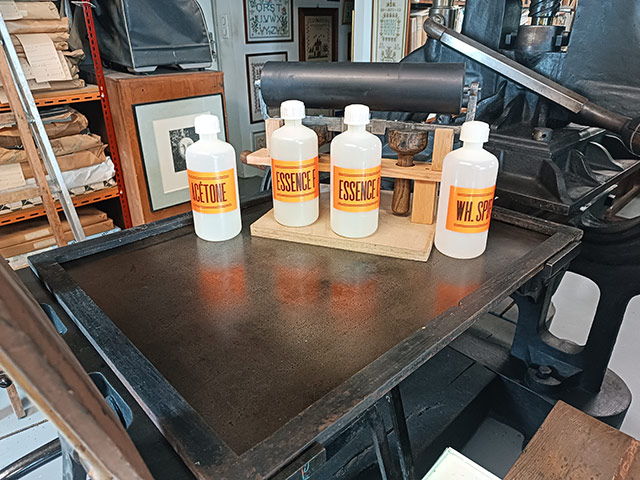
The four cans are sitting on the Stanhope’s bed, each with its handsome label and each filled with its own particular cleaning fluid. They are lined up in front of the two-handled hand roller: acetone, F-type solvent, C-type solvent, and white spirit (also known as turpentine).
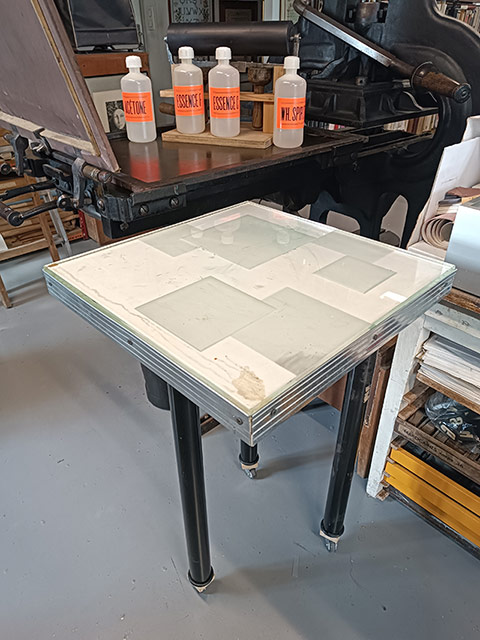
And here is the homemade inking table, cobbled together from all sorts of odds and ends, some of which have been kept for years with the thought: “These little bits and pieces might come in handy someday for making some sort of thing or other. You never know!”
But, but… oh horror!… we discover that the tabletop, made of genuine glass more than 5 millimetres thick, is absolutely filthy. Quick clean-up!
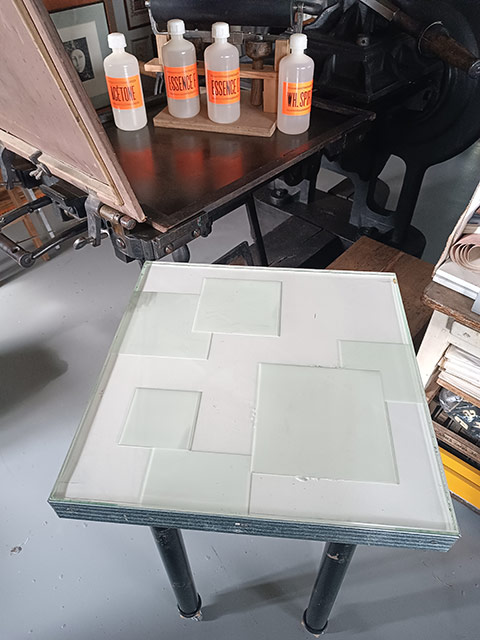
There, that’s better. With the tabletop this clean, even if we want to ink in white, there’s no danger of dirtying the colour… provided, of course, that the inking roller itself is properly clean too.
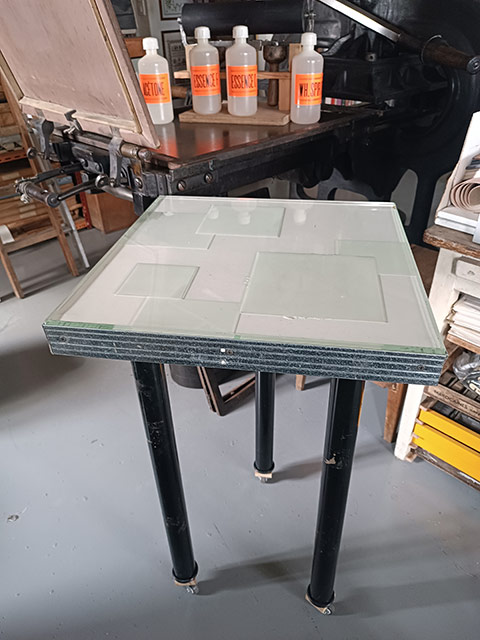
The table has only three legs, but they are fitted with casters, so it can easily be moved around. It wasn’t a deliberate decision to give it only three legs. It’s simply that, in our stockpile of odds and ends for making things out of, we could only find three. So we made do with what we had.
But admit it, it does have a certain style, this little table, with its Art Deco glass and its pretty embossed tin edging. Doesn’t it? You disagree?… Never mind. I don’t care. I like it…
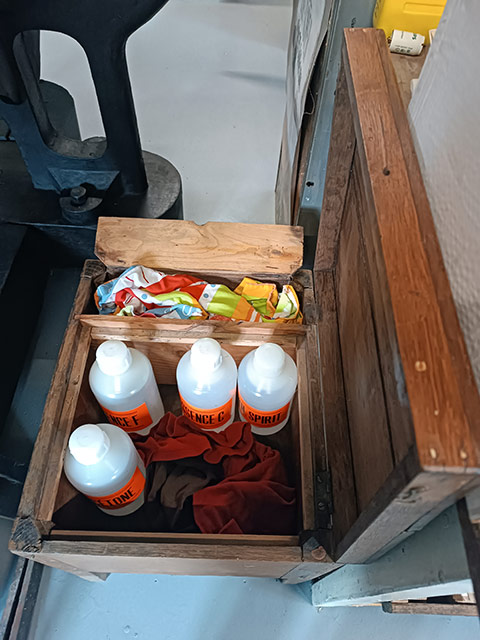
To complete the little setup, let me introduce you to this small box on legs (it has four of them!) which a friend gave me because he no longer had any use for it. I use it to store rags and cans of cleaning fluid. The clean rags, waiting patiently to get dirty, are kept in a small compartment that can be closed with a hinged lid. It’s rather sweet.
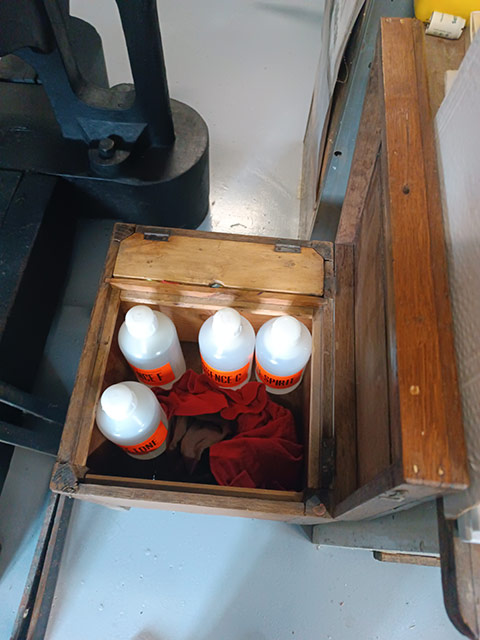
The little lid is closed.
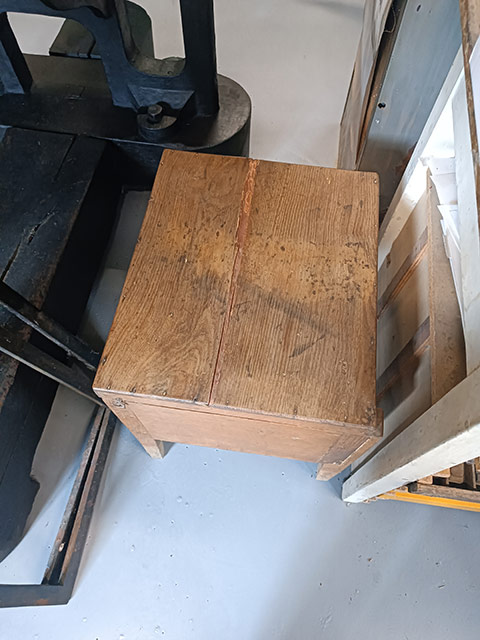
The large lid of the box is closed as well…
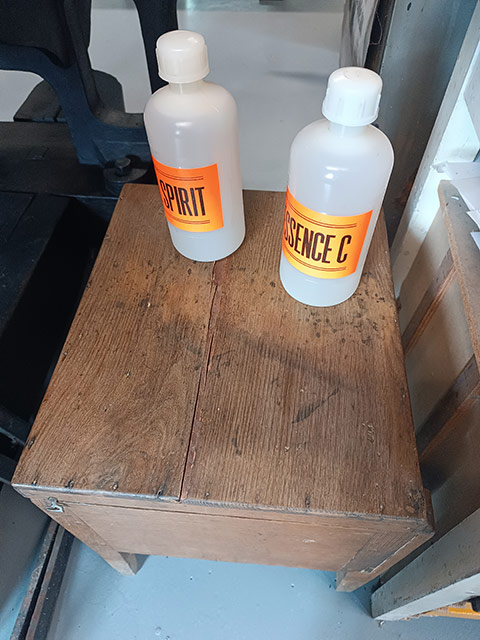
… and the cans of cleaning fluid can be placed on top. Wonderful, isn’t it?
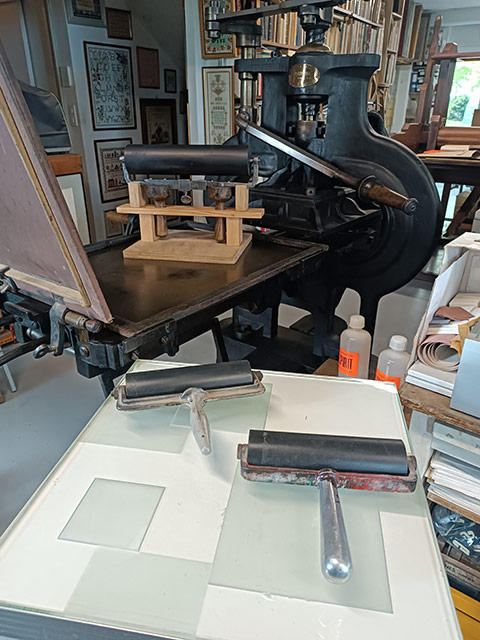
You can also put other hand rollers on the inking table, smaller ones…
—Yes, yes, very nice indeed, old chap, but when are you actually going to use that press of yours?
—Well, er… pfff… when my back hurts a little less from pulling on the bar… Soon… soon…
Not so long ago, as you may remember, I announced here that all the newly arrived Stanhope was still missing was an inking table before the press would have everything it needed to get properly to work. Well, that’s sorted now. The Stanhope has its inking table. And it has even more than that: it now has its very own cans of cleaning fluids, each one sporting a fine label printed in the workshop—black lettering on fluorescent orange paper, so you can’t possibly miss them. Come on, let’s have a look at the pictures…
The four cans are sitting on the Stanhope’s bed, each with its handsome label and each filled with its own particular cleaning fluid. They are lined up in front of the two-handled hand roller: acetone, F-type solvent, C-type solvent, and white spirit (also known as turpentine).
And here is the homemade inking table, cobbled together from all sorts of odds and ends, some of which have been kept for years with the thought: “These little bits and pieces might come in handy someday for making some sort of thing or other. You never know!”
But, but… oh horror!… we discover that the tabletop, made of genuine glass more than 5 millimetres thick, is absolutely filthy. Quick clean-up!
There, that’s better. With the tabletop this clean, even if we want to ink in white, there’s no danger of dirtying the colour… provided, of course, that the inking roller itself is properly clean too.
The table has only three legs, but they are fitted with casters, so it can easily be moved around. It wasn’t a deliberate decision to give it only three legs. It’s simply that, in our stockpile of odds and ends for making things out of, we could only find three. So we made do with what we had.
But admit it, it does have a certain style, this little table, with its Art Deco glass and its pretty embossed tin edging. Doesn’t it? You disagree?… Never mind. I don’t care. I like it…
To complete the little setup, let me introduce you to this small box on legs (it has four of them!) which a friend gave me because he no longer had any use for it. I use it to store rags and cans of cleaning fluid. The clean rags, waiting patiently to get dirty, are kept in a small compartment that can be closed with a hinged lid. It’s rather sweet.
The little lid is closed.
The large lid of the box is closed as well…
… and the cans of cleaning fluid can be placed on top. Wonderful, isn’t it?
You can also put other hand rollers on the inking table, smaller ones…
—Yes, yes, very nice indeed, old chap, but when are you actually going to use that press of yours?
—Well, er… pfff… when my back hurts a little less from pulling on the bar… Soon… soon…

L’homme au coin
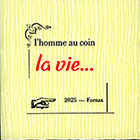
10 pages,
format 8,5 x 8,5 cm.
tirage à environ 30 exemplaires en typographie au plomb.
Thomas Braun
des fromages
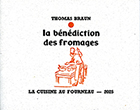
8 pages,
format 11,2 x 9 cm.
tirage à 131 exemplaires en typographie.
CLS
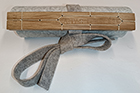
Un volumen,
79 cm de long, 17,5 cm de haut.
tirage à 10 exemplaires en linogravure.
Marie-Rose de France
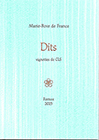
26 petits textes en proses poétique. Vignettes de CLS.
tirage à 120 exemplaires en typographie au plomb.
Marie-Rose de France
|
|
36 p., format 10 x 14 cm. composé et imprimé en typographie au plomb Tirage à 120 exemplaires. (cliquer sur l'image pour en savoir plus) |
... for those who are too lazy to seek.
14550180 visitors
238 visitors online
Fornax éditeur 18, route de Coizard, F51230 Bannes – France

